Eden: Eden Chang solo exhibition
-
Overview

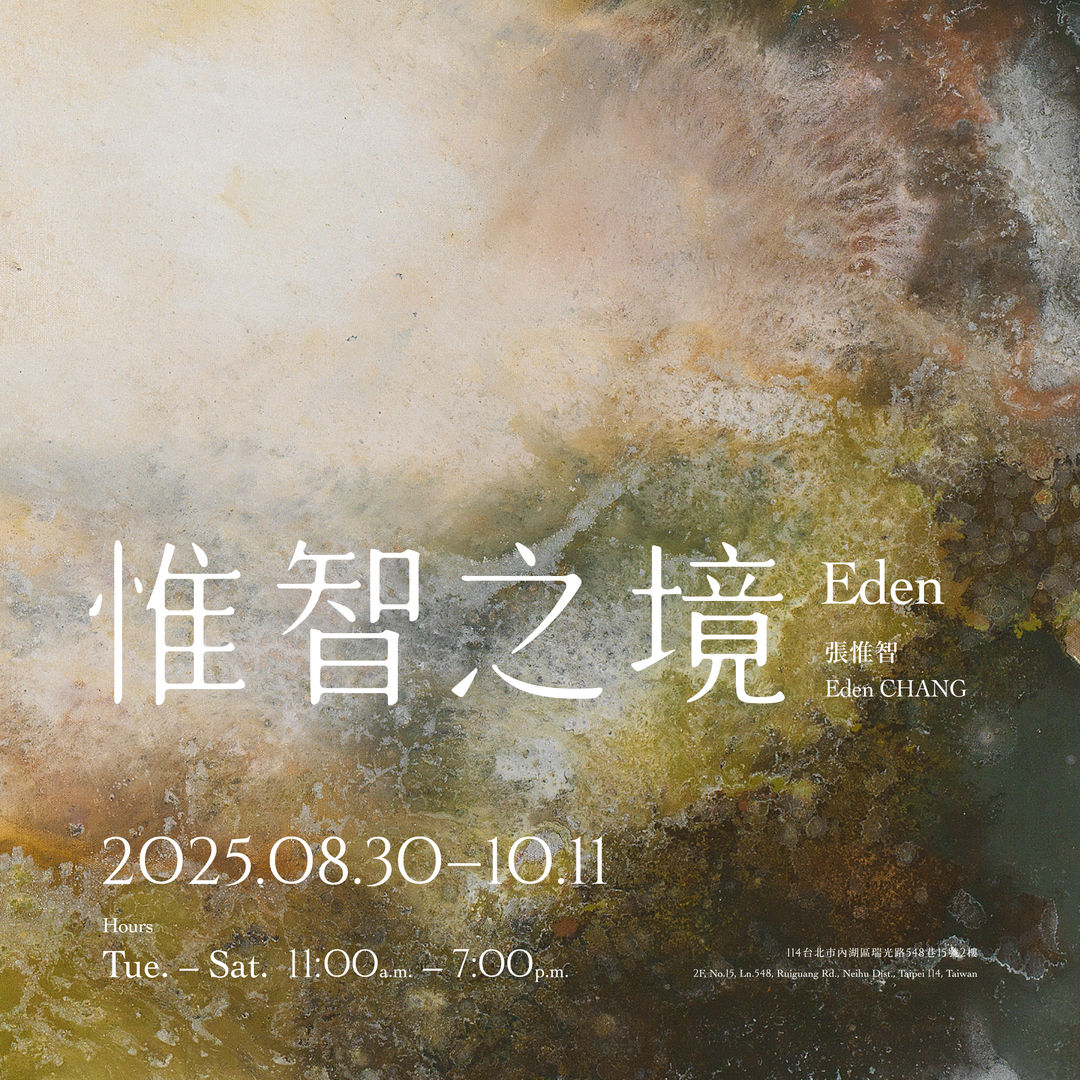
Exhibition Dates | 08.30.2025–10.11.2025
Reception | 08.30.2025 (Sat.) 4:30 p.m.
Venue | 2F, No. 15, Ln. 548, Ruiguang Rd., Neihu Dist., Taipei, TaiwanWithin the discursive framework of Chinese ink painting, the concepts of imagery (yixiang) and artistic conception (yijing) are often understood as genealogically linked—emergence and realization in dynamic continuity. In contrast to the Western pictorial tradition, wherein image and form co-arise in mutual dependence, the ink tradition has, from its inception, sought to transcend the constraints of form (xing), distilling instead the imagery of landscape to articulate a realm of yijing—a poetic space of ease and unity between human and cosmos. Here, jing denotes more than the representation of nature; it gestures toward a state of mind, an inward flux that unfolds across the painter’s gestures and, through the viewer’s perception, coalesces into an imaginative field opened by the painting. The exhibition Eden presents precisely such a terrain: Eden employs the syntax of Western abstraction to engage the Eastern pursuit of yijing, establishing a locus of refuge for vision and awareness between abstraction and spirit.
-
How might the visual lexicon of Western abstraction be reconciled with the Daoist principle of the great form without shape? And how might an artist grounded in Eastern aesthetics respond to the subtle, unbroken rhythm of traditional landscape painting through a language as forceful and disjunctive as abstraction? Eden’s work emerges from the ink painting tradition’s enduring aspiration to render the immaterial—qi, atmosphere, spirit—through the depiction of form. Yet Zhang decisively departs from the representational, abandoning even residual traces of form in favor of pure color and the generative force of abstraction. As Fang Xun, a Qing-dynasty master of ink painting, wrote in Shanjingju Hualun (Treatise from the Studio of Mountain Quietude): “The animation of qi yun (vital resonance) is of utmost importance. When qi is abundant, the brush moves freely, unobstructed, and rhythm arises of itself.”
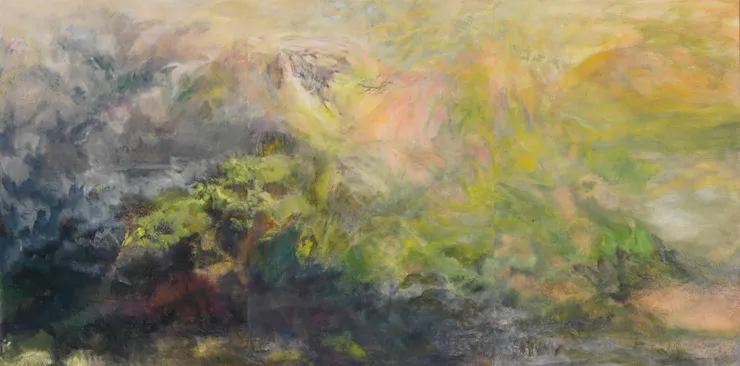
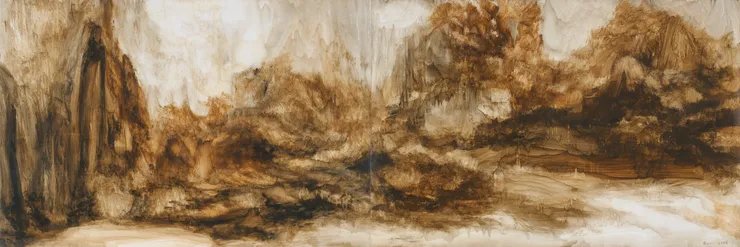
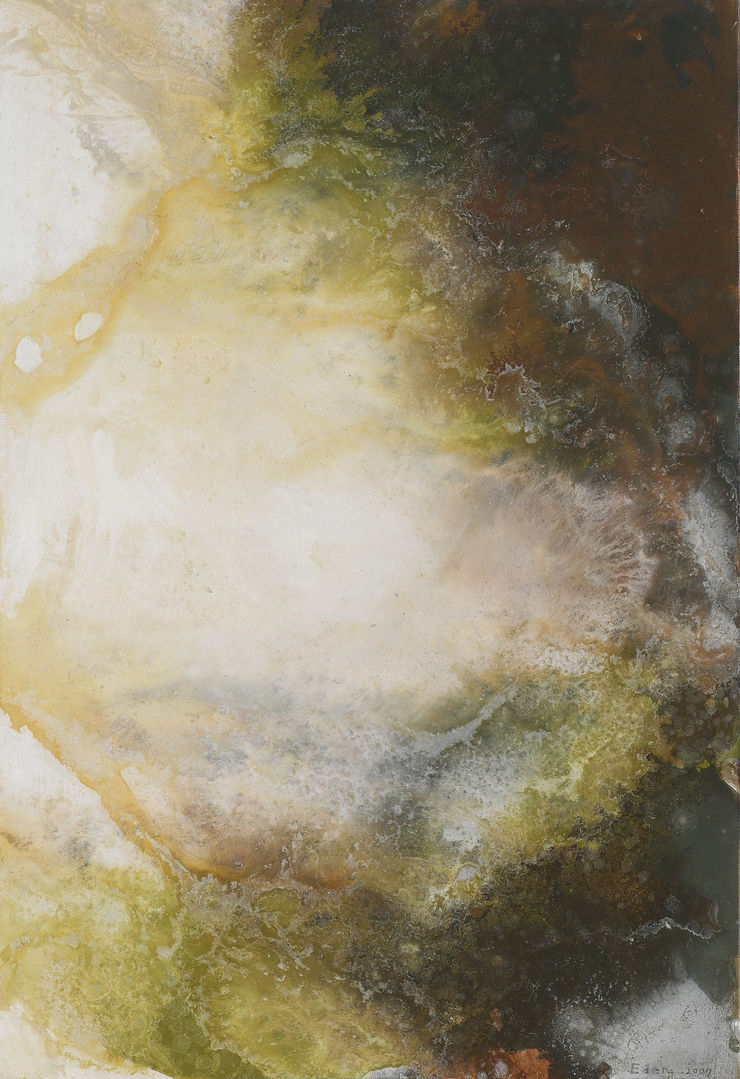
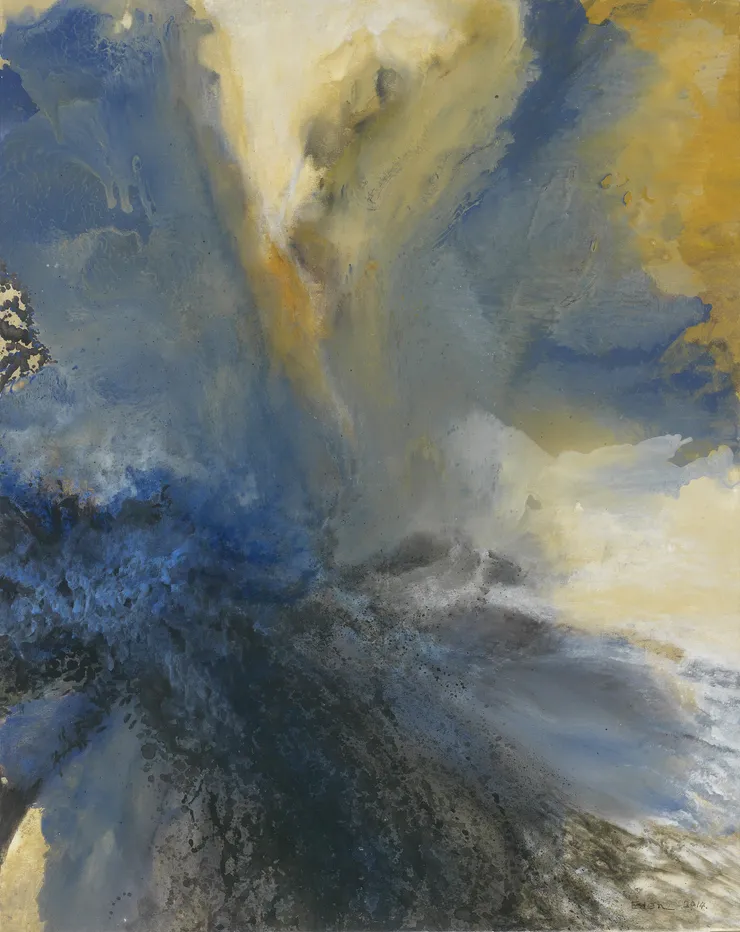
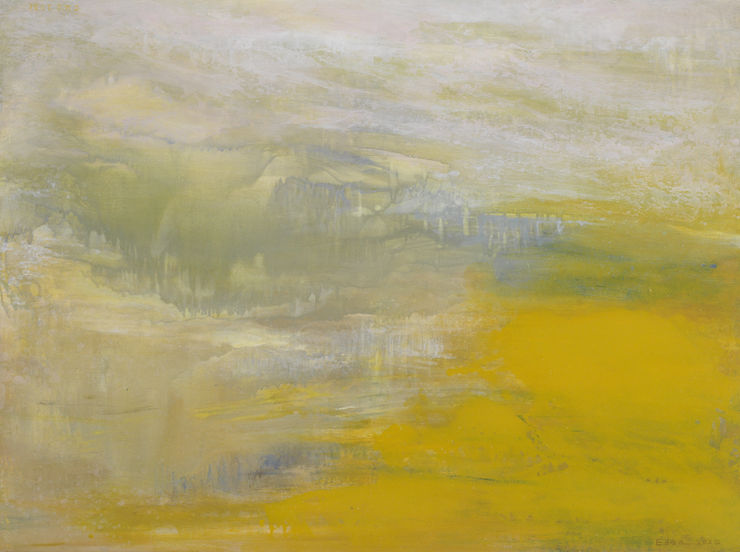
In this lineage of thought, the mastery of voids, tonal gradations, and the evocation of floating mists are not merely technical decisions, but revelations of an artist’s inner cultivation. In Eden’s paintings, we encounter a continuation of this sensibility—through torrents of luminous color that seem to carry with them a latent undercurrent of qi. His use of layered oil pigment generates a mist-like surface, while contrasts between light and dark organize the composition into a tactile order. In Abstraction 4, the weighty brown masses evoke mountainous terrain and deep ravines; in Abstraction 11, indigo and black coalesce into a visual anchor. These dense, physical zones serve to accentuate the buoyancy and agility of lighter passages, rendering flow visible and giving rise to a subtle luminosity—an optical resonance that extends the non-linear, non-directional, and ever-shifting spatial logic of Chinese landscape painting.
-
-
In Eden’s paintings, qi does not emerge from the depiction of landscape, nor does it suggest any narrative impulse. Rather, within surfaces that recall the mist of early spring or the lingering smoke after rain, intangible forms interlace to conjure a drifting, oneiric field of yijing—a projection of the artist’s inward state in the act of creation. Eden has described his process as often unfolding in a single breath, led by intuition and unmediated gesture—calling to mind Joan Miró’s concept of automatism. Yet as the painting evolves, he shifts between deliberate intervention and surrender to the current of color. The final image is rarely premeditated; it arrives, instead, at the threshold of meditation and expressive release.
Zao Wou-Ki once reflected: “Painting is a return to a distant origin.” For Eden, this origin is not only psychological or spiritual, but cosmological—a return that extends outward as much as inward. Here, abstraction becomes a form of metaphysical navigation, echoing the paradoxical vision articulated in the Zhuangzi: “The infinitely great has no outside; the infinitely small has no inside.” Within this dialectic of boundlessness and interiority, his paintings resist closure, pointing instead toward an expansive void where the visible and the invisible, the self and the cosmos, dissolve into one another. It is in this ineffable space—at once intimate and infinite—that Eastern abstraction finds its home.
-
Works
-
The abstract series presented in Eden spans more than two decades of Eden’s artistic evolution. Several works have been revisited and reworked long after their initial completion—traces of color added, atmospheres reshaped—so that the surface never fully settles, remaining suspended in a state of becoming. The flow of color crystallizes in a single moment, yet always gestures toward an unfulfilled continuation. These works do not close upon themselves; they do not arrive at stillness. Instead, they function as vessels of temporal permeability—porous to memory, duration, and flux. In them, the viewer is not merely invited to perceive, but to dwell—to enter a living terrain of the mind, where color, time, and consciousness remain in quiet negotiation.