Tony WONG 1970 – 1980: A World Drawn Together by Lines: Tony Wong solo exhibition
-
Overview

Exhibition Dates│03.07–05.02.2026
Reception|03.14.2026 (Sat.) 4:30 p.m.
Venue │ Tina Keng Gallery (1F, No. 15, Ln. 548, Ruiguang Rd., Neihu Dist., Taipei, Taiwan)
Curator | Hsu Fong-Ray
Co-curator | Liao Chuan-Ya
Curator | Hsu Fong-Ray
Reflecting on the global state post-1945, the early Cold War era did not immediately usher in a new order. Instead, it operated within a framework that was neither stable, transparent, nor fully intelligible. During this period, Chinese society underwent its most violent tremors. These histories were not merely fragments of a grand narrative; they seeped into the fabric of daily life, becoming visceral forces capable of altering one’s destiny at any moment.
-
In the long history of migration from Southern China to Hong Kong, and subsequently to the United States and the United Kingdom, "departure" for the Cantonese people was less a personal choice than a profound historical condition. Under the pressure of political tightening and economic hardship, this evolved into a collective psyche: the belief that a destiny-changing world existed "out there." For the waves of migrants leaving mainland China, Hong Kong was not a destination but a "temporary dwelling"—a city in suspense, caught between colonial governance, Cold War politics, and the shadow of China. To drift across borders toward the New World was a "generational act of migration." It was within this tide that the talented artist Tony WONG moved.
In this exhibition, "Tony WONG 1970–1980: A World Drawn Together by Lines," we have the privilege—through the assistance of artist Ying Hung—to meticulously reorganize WONG’s works from the 1970s and 80s. These pieces reveal a profound departure from his post-80s oeuvre, comprising a vast collection of sketches, collages, slides, and early pastels.
These precious sketches offer a roadmap of the artist's conceptual evolution during his migration. In WONG’s hands, the line is not merely a tool for depiction or contouring; it functions as a "world-measurement tool." He used the line to test the world’s rhythm, gravity, corporeality, and orientation—exploring how a worldview unfolds within the frame. This stands in stark contrast to his well-known 1980s works, which often utilized the layering, overwriting, and consumption of pigment to create a dense yet open materiality, focusing on humanistic and spiritual reflections within mythological structures.
This divergence is not a rupture but a transition. The creative state born from time and displacement serves as a vital nexus leading to his 1980s maturity. In these sketches, we touch upon WONG’s painting as a "site of voicing." Whether involving humans, animals, or mythology, the core remains an ultimate concern for the "human." It could be said that upon arriving in the New World, Tony WONG was not painting America; he was re-creating his own world within America. He rarely responded to America directly, choosing instead to engage with the question of "how the world is reorganized." Here, the line is the foundation of world-making; the body is not just a pose but a node where the world is tethered; the image is not a narrative but the grammar of existence itself. America provided the questions, but WONG’s answer was the world drawn together by these lines.
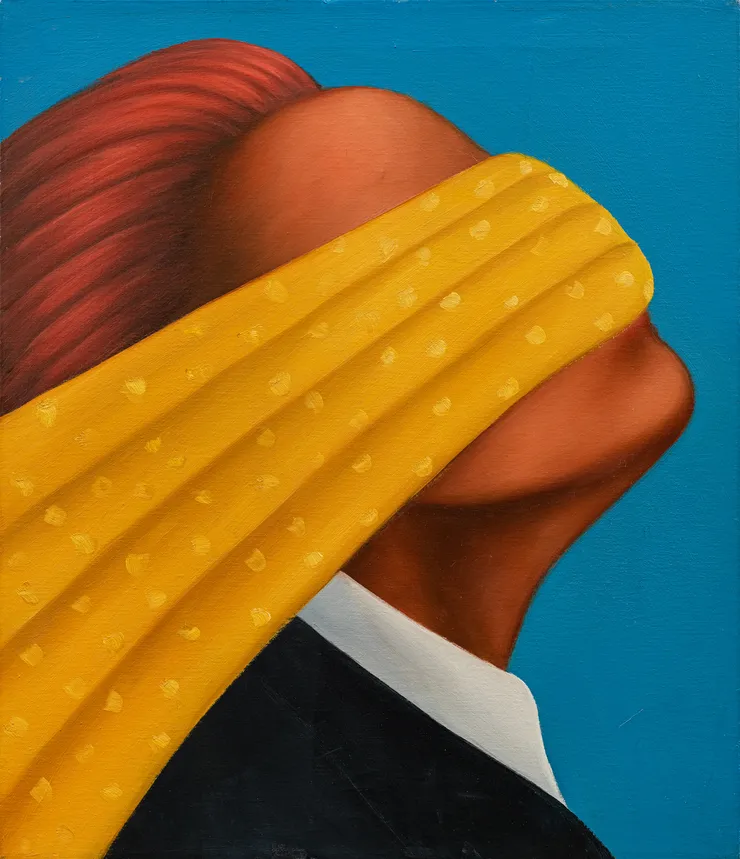
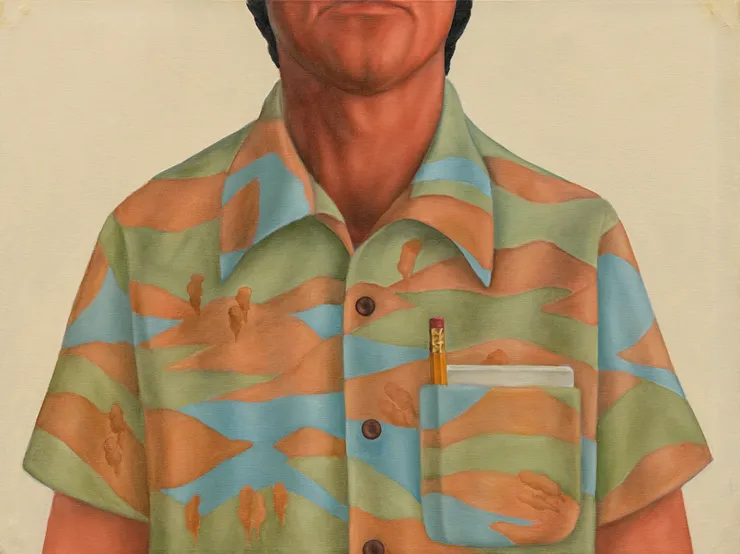
The oil paintings featured in this exhibition, such as No Title, Waiter, and Conversation, often obscure the subjects' faces, leaving only the lower half of the face and the body. While this might initially trigger thoughts on identity politics, the viewer is quickly pulled into a deeper web of human relations. One senses the atmospheric shift of the American art scene as the artist transitioned from Chicago to New York—an experimental phase hovering between Photorealism and Surrealism, revealing a side of Tony WONG seldom seen.
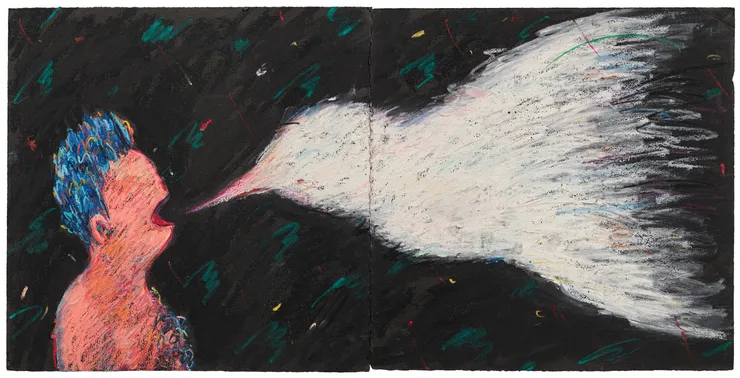
WONG often utilized a single sketch or image as a foundational "seed" to create three distinct forms: pastels, oil paintings, and oil-modeled sculptures. The transition between these media represents the "becoming" of a world across three levels of existence. From the initial perception of the pastel to the final solidity of the sculpture, these are not mere experiments but a complete genealogy of a world transitioning from perception to presence.
With "A World Drawn Together by Lines" as its sub-theme, this exhibition uses the coordinates of era and physical movement to understand the world—not as a concrete landscape, but as a series of vast oceans waiting to be decoded. The exhibition design extends the concept of the "line" into the spatial arrangement, supplemented by collages and slides that provide historical context. This marks the "starting point" of WONG’s line. From here, viewers will discover that Tony WONG did not use painting to record an era; he used the line to record how a migratory life experiences the world. Every stroke is like a breath—an inhalation and exhalation—documenting how a body finds its orientation. In WONG’s work, the world never exists prior to the line; rather, the world is what emerges at the other end of the line’s pull.Note:
The manuscript-like lines on the exhibition walls were drawn collaboratively by gallery staff.
-
Artist
-
-
Works
-
Essays
-
Tony WONG 1970–1980: A World Drawn Together by Lines
Text | Hsu Fong-Ray (Curator)I. A World Yet to Arrive: The Origin of Life in the Fissures Looking back on Tony WONG’s life trajectory, it becomes clear that from the very beginning it was... -
Tony WONG 1970-1980: An America Not Yet Arrived - Introduction
Text | Liao Chuan-Ya (Co- Curator)Tony WONG’s artistic trajectory spans a constellation of cities and cultural landscapes, beginning in Hong Kong, moving through Chicago and Berkeley, and eventually converging in New York. These locations are... -
Tony WONG 1970-1980: The America Yet to Arrive
Text | Liao Chuan-ya (Co-Curator)Tony WONG's works flow like a river, winding their way from Hong Kong through Chicago and Berkeley, ultimately converging into the hustle and bustle of New York. In his early...
-
-
Installation View
-
Previous Publication
-
Tony Wong | Recent Works
NT$ 750 December 1, 2011Essay | Writing Lyrical Monologue in Imagery - Tony Wong Recent Work - Tung-Hsiao Chou Artwork | 2009-2011 Biography -
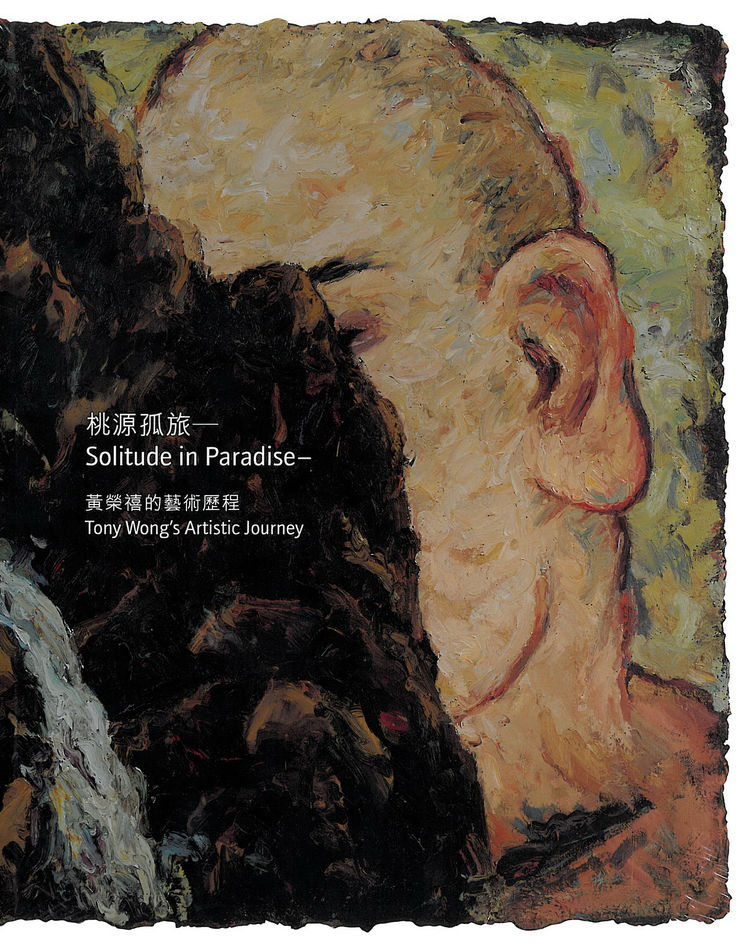
Tony Wong | Solitude in Paradise - Tony Wong's Artistic Journey
NT$ 2,200 May 1, 2009Essay | Solitude in Paradise - Tony Wong's Artistic Journey - Chia Chi Jason WANG Artwork | 1978-1989 1990-1999 2000-2009 Biography
-